Peace Vans
Had pre-production access to the van. The Buzz.Box is a modular camp kit; the Sleeper adds a near-queen sleeping platform. A full Buzz.Camper build is offered too.
Buzz.Box from $7,995 · Sleeper $10,995 peacevans.com →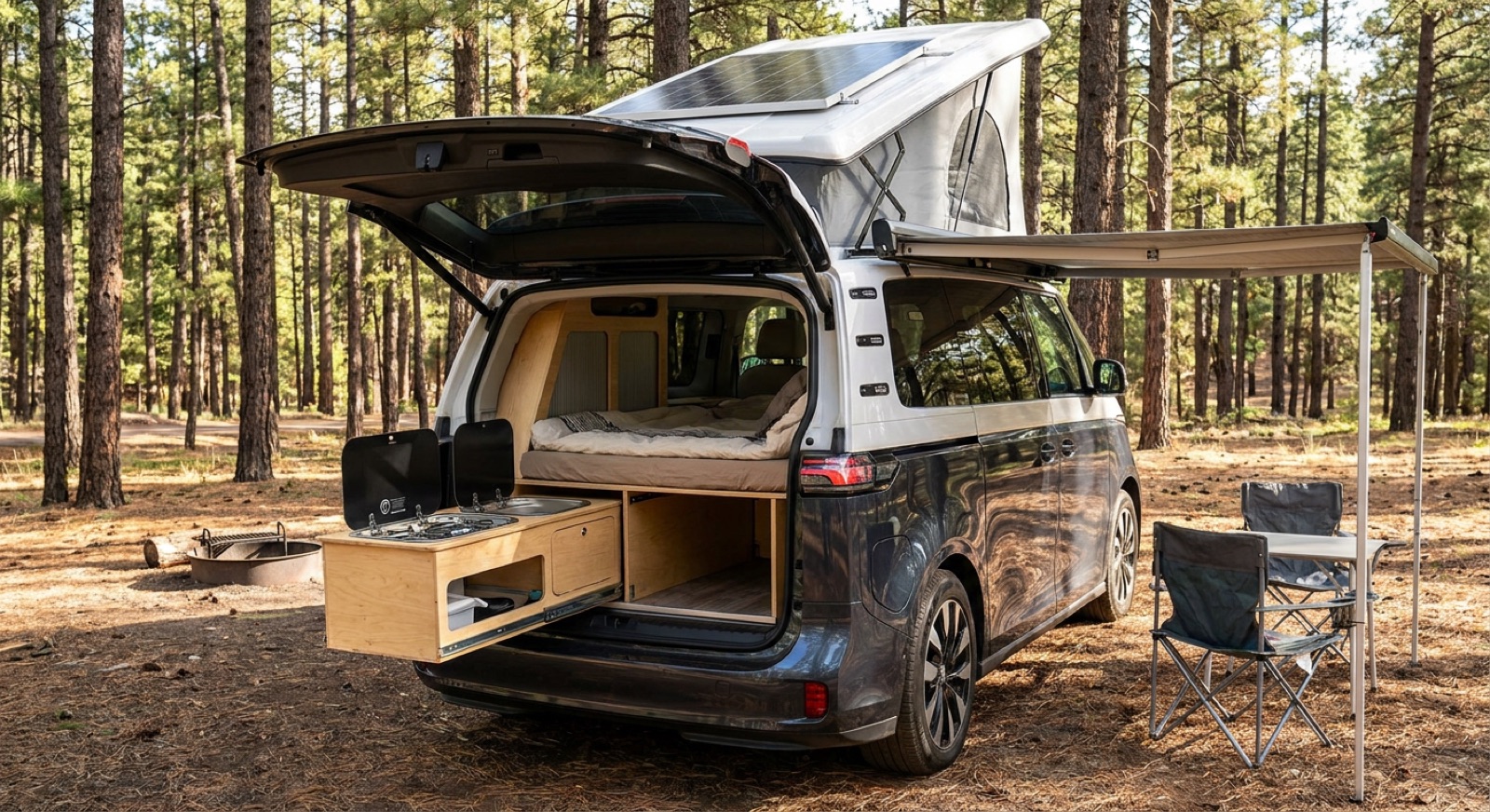
Seven concepts for Volkswagen's electric bus — and a straight look at what it can really do when you park it for the night.
AI-generated concepts · Not VW productsThe Kia EV9 already has Overnight Mode by another name. The Rivian levels itself. And a used 2025 is still the actual bus.
VW told dealers today the American return slips another year. A month ago a dealer told us November or December.
BrightDrop dodged the tariffs, got adopted by RV builders, and sold fewer than 4,000 units before GM shut it down. The tariff story isn't the whole story.
VW's electric California, bidirectional charging, now Kia's PV7 — three announcements in a month, none of them for the US. A 1964 chicken tariff explains more of it than you'd think.
Everything VW has actually said, the trim question nobody can answer, and where that 48-hour figure really came from.
The Transit is the better camper, the Buzz is the better vehicle — plus the Co-Pilot360 catch that bites people who buy a cargo van off the lot.
The ID. California Cruise, unveiled at Caravan Salon. Full specs, the bed drawn to scale, and where that "48 hours" figure actually came from.
Twenty ID. Buzzes in Bellingham, real camper conversions, and what a VW dealer would and wouldn't tell us about 2027.
The quietest campsite you have ever woken up in.
Every camper van makes a trade. Run the heat and you run an engine, or a generator, or a propane furnace with a carbon-monoxide detector blinking above your head.
An electric van doesn't make you choose. The ID. Buzz Tourer holds a cabin temperature overnight on battery — no idling, no exhaust, no noise, nothing to vent. That is a genuinely different way to spend a night outside, and it's the reason this van is worth thinking about as a camper at all.
This site collects concepts for what a full conversion could look like, alongside the real, verified details of what Volkswagen is actually shipping. We keep those two things clearly separated.
The feature that matters
Volkswagen built a software mode specifically for sleeping in the van. Their own description is a single sentence: Overnight Mode "adapts interior and exterior functionality to enable the vehicle to be used for overnight stays."
There's no engine involved. The van sits silent and draws from the same high-voltage battery that moves it — nothing burning, nothing to vent, no carbon-monoxide detector over your head. That's the whole argument for an electric camper, and it's why this unglamorous feature is the most interesting thing about the 2027 van.
It also raises questions Volkswagen hasn't answered: whether it's exclusive to the Tourer trim, how long it really holds temperature, and what a night costs you in range. We've collected everything that is and isn't established.
What VW is actually shipping
Updated 24 September 2026: Volkswagen has told dealers the ID. Buzz's American return is delayed again — it now comes back as a 2028 model, in the 2027 calendar year rather than this autumn. What that means →
The specification below was announced for model year 2027. Volkswagen has not said whether the Tourer camping trim carries over to 2028 unchanged, so treat it as the most recent published intent rather than a confirmed 2028 car.
No pop-top. No kitchen, sink, or plumbing. What you get is a flat place to sleep, darkness, airflow, and somewhere to sit outside. For a lot of people that is genuinely enough. For everyone else, that gap is what the rest of this site is about.
Concepts
None of these exist. They're generated concepts — a way of thinking through what fits inside this van, from a weekend sleeping platform to a full Scandinavian galley. Click any of them to look closer.
A full-width bed sitting above a galley that slides out the back. Sleeps two, still seats four. The least invasive version of the idea.
AI-generated conceptThe maximalist take. Induction cooktop, sink, fridge, an indoor shower with hot water, house battery and solar. Pale wood everywhere.
AI-generated conceptBuilt for staying out longer. A 74 × 48-inch bed, modular cabinets, under-bed drawers, a dual battery system and an optional exterior shower.
AI-generated conceptThe classic answer: put the bed in the roof and get your floor back. Two sleeping levels, standing room, and the smallest footprint at camp.
AI-generated conceptKitchen down the side, bed in the roof, everything else out of the way. Fire pit optional but strongly implied.
AI-generated conceptThe lived-in one. Solar on the roof, a fridge and a small galley inside the sliding door, camp chairs already out. Less showroom, more Tuesday.
AI-generated conceptThe most plausible of the seven — a pop-top with solar, an awning, and a kitchen that slides out the back. Close to what shops build today.
AI-generated conceptAvailable now
You don't have to wait for Volkswagen. A handful of shops are already converting the ID. Buzz, and a few of them are in the Pacific Northwest.
The obvious worry is what a conversion does to your range. Early figures from Peace Vans pop-top customers put the penalty at roughly 7 to 10 miles for about 250 pounds of added weight — less than most people expect, though it's early data from one shop rather than a controlled test.
Had pre-production access to the van. The Buzz.Box is a modular camp kit; the Sleeper adds a near-queen sleeping platform. A full Buzz.Camper build is offered too.
Buzz.Box from $7,995 · Sleeper $10,995 peacevans.com →Pop-top conversions engineered for the electric platform, plus suspension upgrades, swivel seats, hitches and off-road kits.
Quoted per build titanvans.com →Drop-in conversion kits with a bed, storage and an integrated kitchen. Comes in a four-passenger version that keeps your seats, or a two-passenger version that doesn't.
Kit pricing on site roadloft.com →Volkswagen's own camper kit — a sleeping platform sized for two adults, with an orange or gray mattress. The simplest possible starting point.
Dealer accessory See the 2027 details →We're tracking the electric California, the 2027 Tourer, and whatever the conversion shops build next. Leave your email for the occasional update — no more than a couple a month — and if you've got something to tell us, the second box is the place.
No spam, and we won't sell your address.