14 September 2026
EV campers are having a party and America hasn't been invited
Three announcements in four weeks, each one a genuine step forward for sleeping in an electric van. Not one of them is coming here. That isn't a conspiracy or an oversight — it's a tariff about chickens from 1964, an eight-figure certification bill, and a spreadsheet that keeps coming out the same way.
The pattern
Four weeks, three vans
28 August — the ID. California Cruise. Volkswagen's first fully electric California, unveiled at Caravan Salon. A purpose-built sleeping platform, blackout blinds throughout, 2 kW of vehicle-to-load, and California Mode holding cabin temperature up to 48 hours. From €60,761, deliveries early 2027. Not planned for America.
10 September — bidirectional charging. The ID. Buzz Pro gains vehicle-to-home and vehicle-to-grid, turning the van into a power source for a house or a campsite. Confirmed for Australia, reported for Europe. Volkswagen's US 2027 announcement doesn't mention it once — we checked the release itself, not the coverage.
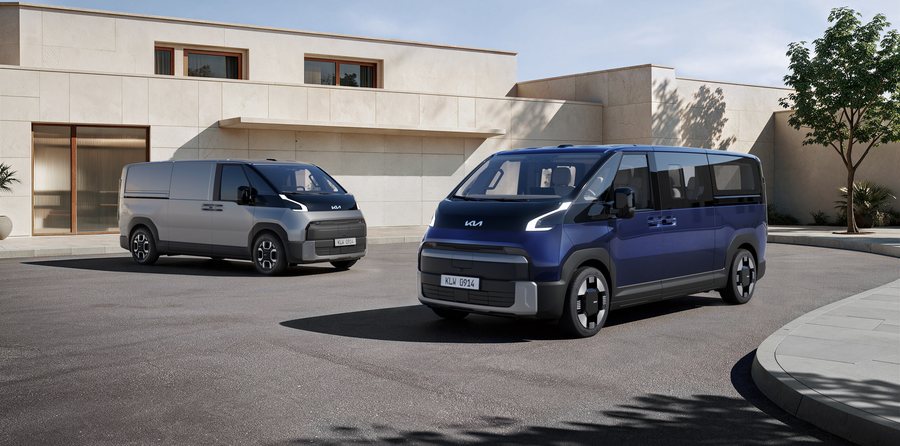
14 September — the Kia PV7. An 800-volt electric van with 71.5 and 96.2 kWh batteries, around 460 km WLTP, removable rail-mounted seats, and vehicle-to-load through both interior and exterior outlets. Korea and Europe in the second half of 2027. Kia has not announced pricing — the only figures circulating are third-party guesses — and American availability is unconfirmed.
Each is the kind of thing that makes camping in an electric van meaningfully better. Collectively they describe a category maturing somewhere else.
The mechanism
A tariff about chickens
In 1964, in retaliation for European tariffs on American poultry, Lyndon Johnson imposed a 25% duty on imported light trucks. It was meant to be leverage in a trade dispute about chicken. Sixty-two years later it is still law, and it still applies to commercial vans built outside North America.
This is not trivia. The chicken tax is the stated reason the ID. Buzz Cargo isn't sold in America — a quarter added to the landed cost of a van that already isn't cheap. Campers are typically built on exactly these commercial platforms. Volkswagen's California is built on the Transporter, which Volkswagen does not certify for the United States at all.
Then there's certification. Federalising a European model — crash testing, emissions, lighting, the entire regulatory apparatus — was estimated by the Center for Automotive Research to cost a European manufacturer upward of $10 million per model. That figure is from 2017 and is unlikely to have fallen.
So the arithmetic is: add a quarter to the price, spend eight figures for permission to sell it, and divide across a market you're not sure exists.
That explains the imports. It doesn't explain the one electric van America built for itself, which was exempt from all of this and got cancelled anyway.
The part that stings
They don't think we'll buy them
The regulatory costs are real but they are not the whole answer, because Volkswagen has been fairly direct about the rest of it: they don't believe the American market for a camper van is big enough to justify the expense.
It's hard to argue they have no evidence. The ID. Buzz's first American run was not a success — reportedly around six thousand units in 2025, at an average north of sixty thousand dollars — after which Volkswagen skipped the 2026 model year entirely before returning for 2027.
That's the uncomfortable shape of it. Americans say they want the bus. The sales figures say something more complicated, and every executive deciding whether to spend $10 million on homologation is looking at those figures rather than at the enthusiasm.
There is a version of this that improves. Volkswagen has said it expects demand to grow toward the end of the decade and has pointed at that window for a possible ID. Buzz California. That is a long way from a product plan, but it isn't nothing.
The honest counterweight
The gap is narrower than it feels
It would be easy to write this as pure grievance. It's worth resisting, because the thing Europe is getting is less than the anticipation suggested.
The ID. California Cruise has no kitchen. No sink, no cooktop, no fridge, no plumbing. It is a bed, blinds, a table and two chairs. The American ID. Buzz Tourer is a fold-out mattress, blinds, ventilation panels, a table and chairs. Those two lists are closer than anyone expected.
The American van also has a larger battery — 91 kWh against 79 or 86 — and all-wheel drive, which the Cruise doesn't offer.
The genuine gaps are two. Europe gets a purpose-built sleeping platform rather than a mattress over folded seats. And Europe gets vehicle-to-load, which is the one that actually matters: two kilowatts from the van is the difference between somewhere to sleep and somewhere to live for a weekend.
What to do about it
This is why the conversion shops exist
The American answer to sixty years of van tariffs has always been to buy the van you can get and modify it yourself. That's the whole reason a conversion industry exists here in a way it doesn't in Europe, where you can simply order a California.
So the practical response to this month's news is unchanged: buy the ID. Buzz if you want it as a vehicle, get the Tourer if Overnight Mode matters to you, and add what Volkswagen won't sell you. A pop-top from a shop in Boulder. A galley from one in Seattle. A power station in the back, since the van won't give you outlets.
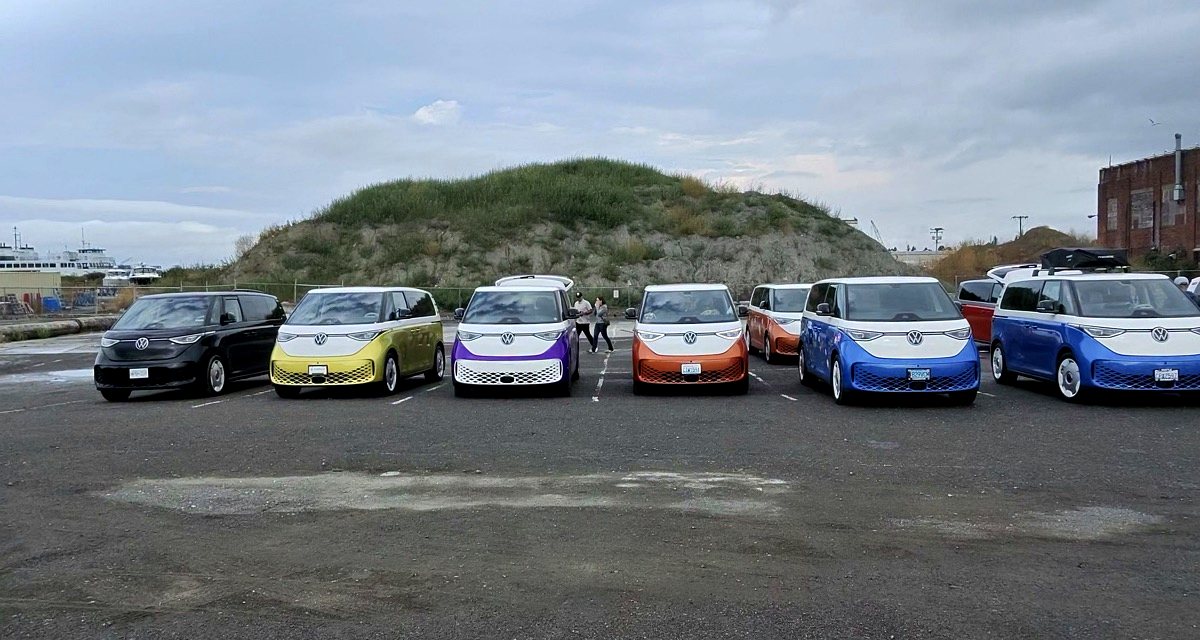
It's more expensive and less elegant than ordering it from a dealer. It is also the only route that exists, and the twenty vans in a Bellingham parking lot last month suggest people are taking it anyway.